At 9 p.m. on July 25, 2022, four Douyin car reviewers posted videos about the same car in the same minute. It was the SL03, the first model from Deepal, an electric-car brand Changan Automobile had set up that April, and it went on sale that evening. Between July 25 and 31, 18 creators posted 19 sponsored videos, those four included, under one hashtag, #20万级电轿王炸, roughly “the knockout among ¥200,000 electric sedans.” Six repeated the same line: 超级智能、超级续航、超级三电, “super-smart, super range, super battery and motor.” Xingtu, Douyin’s creator marketplace, recorded 186 million plays on the 18 for which it reported plays.
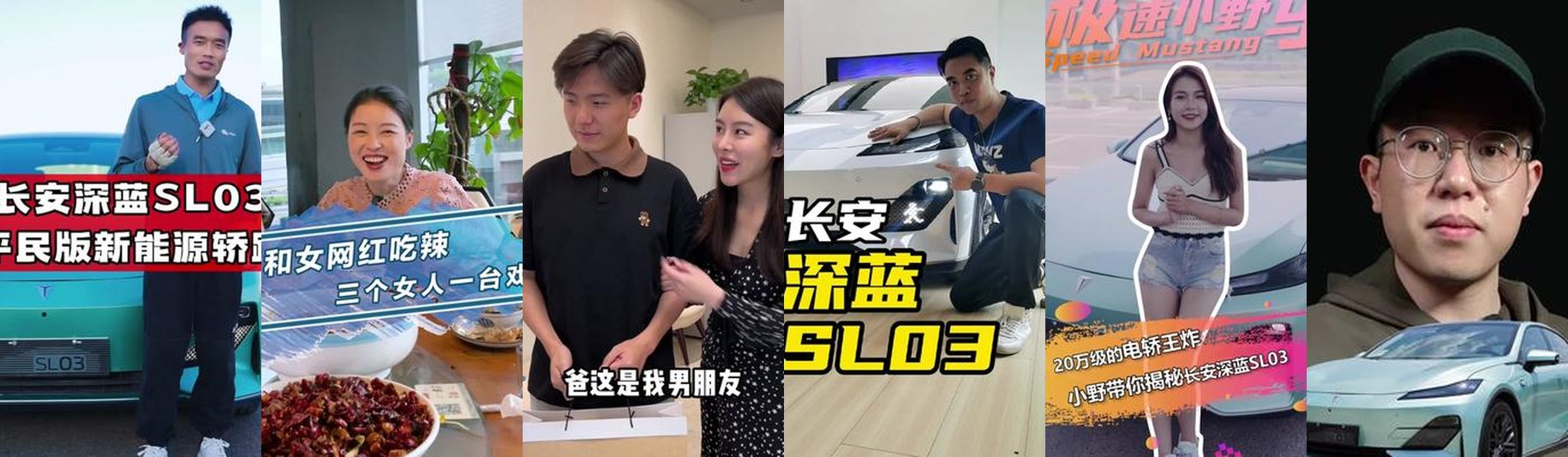
The car carried a new name, Deepal, beside Changan’s own. Ten of the twelve established Chinese carmaking groups in unrandom’s archive have at least one separate brand in it for new-energy vehicles, the battery-electric, plug-in hybrid and range-extended cars China counts together. Each was a newly introduced name, and the archive holds the creator campaigns that introduced them.
The archive holds 2,239 paid car campaigns from 2018 to 2026 on Douyin, China’s version of TikTok, and Xiaohongshu, a lifestyle app where posts are called notes. It shows the new names gaining share of those campaigns and records what the posts said. Among the captured campaigns for Chinese brands that sell only new-energy vehicles, most were for new labels launched by old companies, not for start-ups. In a separate sample of Douyin posts from 2025 and 2026, posts naming those labels more often carried a paid-order marker than posts naming BYD, Xiaomi or the foreign brands.
Old names and new ones
The archive groups sponsored posts into campaigns: one brand, its campaign hashtags and one burst of activity. On Douyin the posts are Xingtu orders or posts marked as ads; on Xiaohongshu they are notes the brand reported as partnerships. We sorted every Chinese car brand in it into three kinds with a fixed rule. Established names are those a group already sold petrol cars under, such as Haval, Changan, Geely and BYD. New names are brands launched by those same groups that sell only new-energy vehicles: Changan’s Deepal and Avatr, Dongfeng’s Voyah, Geely’s Zeekr and GAC’s Aion, for example. Start-ups are new-energy carmakers with no older car brand, such as NIO, XPeng, Li Auto, Leapmotor and Xiaomi, the phone maker, whose first car went on sale in 2024.
In 2021 established names ran 77% of Chinese brands’ paid car campaigns on Douyin. In 2024 they ran 28%. New names rose from 10% to 48%.
UNRANDOM / DOUYIN · CHINESE BRANDS’ PAID CAR CAMPAIGNS · 2020–2025
New names gained the most share
Established namesNew names from established groupsStart-ups
Start-ups gained less. In 2021 they ran more of these campaigns than the new names did, 23 to 16. In 2023 the new names ran 115 and the start-ups 36. On Xiaohongshu, where the archive’s car campaigns begin later, new names went from 34% of Chinese brands’ campaigns in 2022 to 44% in 2024.
The number of names grew too. Two new names had paid Douyin campaigns in 2020 and nineteen did in 2023. Across the archive there are 25, from ten groups. Changan has three: Deepal, Avatr and Qiyuan. Geely has five.
BYD went the other way. It stopped making petrol cars in March 2022 and kept selling under its own name, so it stays among the established names here. In 2025 it sold 4.6 million new-energy vehicles, about a million of them abroad.
Among Chinese brands that sell only new-energy vehicles, the new labels of existing carmakers ran 115 of 151 Douyin campaigns in 2023 and 60 of 90 in 2024. Start-ups ran the rest.
Messages and creators
The posts for new names talked about what the car could do. On Xiaohongshu, 23% of notes for new names mentioned driver-assistance systems, automated parking or the software in the dashboard screens, against 16% of notes for established Chinese names and 9% for foreign brands. In Douyin videos with a machine transcript the shares were 30%, 20% and 18%. Twelve of the fourteen new names with enough notes were above the foreign brands’ average.
UNRANDOM / PAID CAR POSTS · 2022–2024
New names and start-ups talked technology most
Xiaohongshu notesDouyin transcripts
Start-ups mentioned the technology about as often, in 22% of their Xiaohongshu notes. On this measure the new names’ posts resembled the start-ups’ more than they resembled posts for the established Chinese names.
Many of the creators also posted for other kinds of brand. On Xiaohongshu, travel was the most common subject of the creators with partnership notes for new names, about two in five of them; it was also the most common for foreign brands, at about a third. On Douyin, creators whose profile category is cars came first for every kind of brand and comedy and skits second. Of the 2,255 Douyin creators with sponsored posts about a new name, 1,094 also posted about a foreign brand. Their moves between foreign and Chinese brands ran in both directions, at about the rate a random reshuffling of brands over the same dates would produce. The records show no exclusive arrangements.
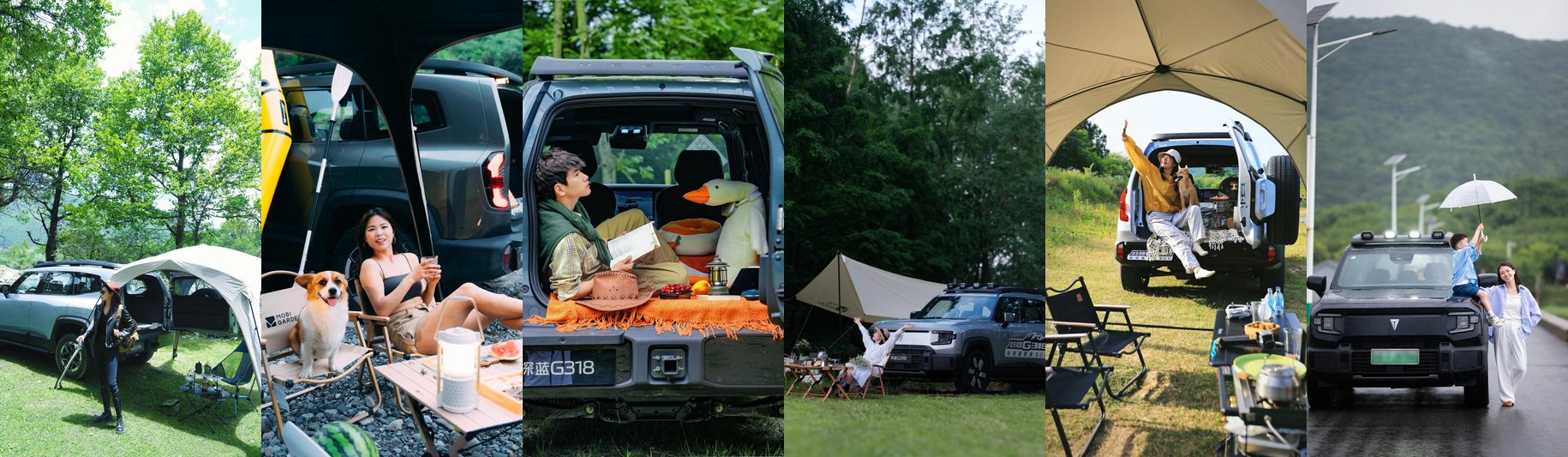
In June 2024, fifteen Xiaohongshu creators posted partnership notes for Deepal’s G318, a boxy SUV that several of the notes describe as range-extended: a petrol engine charges the battery. Fourteen of the fifteen mention camping, and most of the creators post about travel and the outdoors.
Mentions outside the campaigns
Campaigns contain only sponsored posts. For a wider view, we drew a repeatable 3% sample of the roughly 127 million Douyin posts unrandom has collected from creators in its repository and kept those that match car terms. Posts made from January 2025 onwards and collected again after July 16, 2026 keep Xingtu’s order marker, which records that the post was ordered through Xingtu. In that set, 43,442 posts match car terms and 921 carry the marker; 36,246 of them name one of the brands compared below. A post without the marker may still have been paid for some other way.
Of the posts naming a new name, 5.6% carried the marker: 223 of 3,987. For BYD the share was 1.5%, 42 of 2,779, and for foreign brands 1.4%. Start-ups were at 3.1%, other established Chinese names at 2.3%.
UNRANDOM / DOUYIN · 3% SAMPLE · POSTS FROM 2025 ON
New names had the highest marker share
SELECTED NAMES · SAME SAMPLE
Avatr’s was the highest tested
A marked post was ordered through Xingtu; it may have been paid for by a seller or another brand rather than the one named. Unmarked posts include other kinds of promotion. Download data (CSV)
For Avatr, one mention in eight carried the marker (30 of 236); for Voyah and Deepal, one in nine (41 of 362 and 11 of 98). For Xiaomi it was one in fifty (13 of 659) and for BYD one in sixty-six. The new names varied: Zeekr and Geely’s Galaxy were at 2.5% and 2.2%, close to the 2.1% average across all brand-naming posts.
Older names generally had low shares, whether or not they paid creators heavily. Listed rates are the prices creators advertise on Xingtu and Pugongying, the platforms’ creator marketplaces, not what brands paid. Volkswagen’s brands have the largest total at listed rates of any group in the archive, ¥388 million, and 1.6% of Volkswagen’s mentions carried the marker. BYD’s brands total ¥62 million. The archive has no Tesla campaign; the single campaign labelled with its name turned out to be charger and accessory sellers.
Xiaomi was a new car brand with a low share. Its founder, Lei Jun, had 42.7 million Douyin followers by April 2026, and a 2024 livestream of him driving the SU7 drew 39 million views.
The foreign brands
Foreign carmakers sell in China mostly through joint ventures with Chinese companies. In the archive their electric models appear under the old badges, Toyota’s bZ and Nissan’s Ariya for example. GM’s brands have the third-largest total at listed rates of any group, after Volkswagen’s and Great Wall’s.
Tesla cut its Chinese prices on January 6, 2023, and that March the Hubei government and Dongfeng jointly paid for discounts of up to ¥90,000 on Dongfeng-made cars. Between 2022 and 2023 the comments under foreign brands’ posts turned to price more than those under Chinese brands’. Among foreign makes with at least fifty commented Douyin posts in both years, the share of posts whose top comments raised price, discounts or resale value went from 13% to 21%, and it rose for six of the eight. For Chinese makes it went from 15% to 18% and rose for half of them.
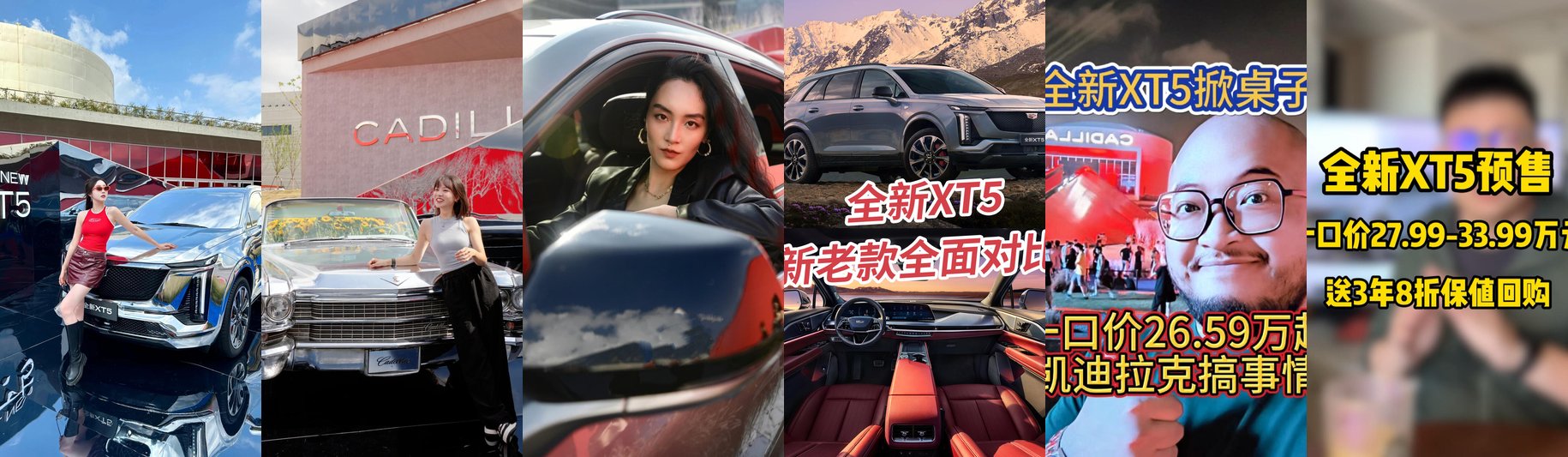
In 2024 Cadillac’s own paid notes carried the price. The notes describe the launch of a new XT5 in Shanghai on September 28, 2024, at an art installation in the West Bund oil-tank park. Between September 16 and October 1, 57 Cadillac partnership notes on Xiaohongshu mention a fixed price, 一口价, the no-haggling price SAIC-Volkswagen and Buick had also adopted that year. Fifty-two give the starting figure of ¥265,900; one sets it beside the list price of ¥399,900. Twenty-eight call the XT5 a luxury petrol car.
Between 2020 and 2025 Volkswagen’s deliveries in China fell from 3.85 million to 2.69 million, and Honda’s from 1.63 million to 645,000.
Names merged, halted or restructured
Several electric names in the archive have since been merged into other lines, halted or put through court restructuring, new names and start-ups alike.
| Name | What happened | In the archive |
|---|---|---|
| Rising Auto (飞凡), SAIC | Folded into Roewe, Nov 2024 | 14 campaigns, ¥56.0M |
| Neta (哪吒) | Court reorganization, June 2025 | 24 campaigns, ¥26.7M |
| HiPhi (高合) | Production halted, Feb 2024 | 10 campaigns, ¥10.0M |
| Geometry (几何), Geely | Merged into Galaxy, Oct 2024 | 11 campaigns, ¥10.0M |
| WM Motor (威马) | Court restructuring, Dec 2023 | 5 campaigns, ¥5.7M |
| Aiways (爱驰) and Jidu (集度) | Aiways to stop selling in China, Mar 2024; Jidu renamed Jiyue | 3 campaigns, ¥3.1M |
| Jiyue (极越), Geely and Baidu | Departments dismissed, production stopped, Dec 2024 | 3 campaigns, ¥0.7M |
Paid campaigns in unrandom’s archive and their total at creators’ listed rates, which are not invoices. Download data (CSV)
Rising Auto has the largest listed-rate total of them. In the thirteen months from August 2022, SAIC ran fourteen paid campaigns for it, worth ¥56 million at listed rates. One on Xiaohongshu, from November 22 to December 28, 2022, paid for 102 notes under hashtags that included 大号modely, “a bigger Model Y,” and 屏霸, “screen king.” The campaign introduced the name by comparison with Tesla’s Model Y and by its screen.
Groups are now combining some of the names they kept. In April 2026 Changan said it would combine the research and supply chains of Deepal and Avatr, which keep separate brands, to cut costs by as much as 30%.
In the mention sample, Avatr and Deepal had two of the three highest marker shares among the names tested. The archive holds 82 paid campaigns for the two, beginning with Avatr’s first captured campaign in May 2022 and Deepal’s SL03 launch that July.
Sources and method
Data. unrandom’s campaign archive groups sponsored posts into campaigns by brand, hashtag and burst of activity. On Douyin, members are paid Xingtu orders or ad-marked posts; posts from brand-owned, store and dealer accounts are excluded, so this is paid creator activity and not all car content. On Xiaohongshu, members are notes the brand reported as partnerships through Pugongying. A fixed rule matched campaign brand labels to car makes, and campaigns whose generated summary placed them outside cars were dropped. That gives 2,239 campaigns (1,812 Douyin, 427 Xiaohongshu) with 24,927 distinct Douyin videos and 11,991 Xiaohongshu notes. One campaign labelled Tesla was removed because its posts were charger and accessory sellers tagging the brand.
Kinds of name. Foreign brands include joint-venture and imported brands, Tesla, and Volvo, Polestar, Lotus and smart, which Geely controls. Among Chinese brands, a new name is an electric-only brand launched by a group that already sold petrol cars under another name; a start-up is an electric-only company without one. BYD, Lynk & Co, Haval and Changan count as established. Ora counts as a new name and AITO as a start-up. Counting Ora as established puts the new names at 4% in 2021 and 46% in 2024; counting AITO as a new name puts 2024 at 54%. These labels were assigned by a deterministic script; no model labelled any record for this article. Upstream, unrandom’s pipeline used model judgments to resolve each campaign’s brand and generated the summaries used to drop non-car campaigns.
What capture covers. The archive is not a census. QuestMobile counted more than 7,000 paid car posts on Douyin and Xiaohongshu in the first quarter of 2023; the archive holds 3,575 for that quarter. Capture changes by year, and car campaigns fall as a share of all captured Douyin campaigns in 2024, so the article compares shares within a year rather than totals across years. 2020 and 2025 on Douyin, and the years outside 2022–2024 on Xiaohongshu, are thin. The shift from established to new names holds when counting posts instead of campaigns and when the largest make of each kind is removed.
Measures. Listed rate is the creator’s posted price for that format when the archive captured it, not what a brand paid. Technology language is a keyword rule (智驾, 智能驾驶, 自动驾驶, 辅助驾驶, 自动泊车, 智能泊车, 智能座舱, 车机, 语音控制, NOA, 激光雷达) matched as written (case-sensitive) in Xiaohongshu titles and text and in Douyin machine transcripts, 2022–2024, counting each post once per make. New names stay above established and foreign names with each make weighted equally, with hashtags removed and with the largest make of each kind left out; the order between new names and start-ups changes. Transcripts cover a smaller share of foreign brands’ videos than of new names’. Model, price and equipment could not be matched. Creator subjects come from current Xingtu and Pugongying profiles. Price talk in comments uses the top-liked comments stored for about 47% of Douyin posts, matched with 价格, 售价, 落地, 性价比, 保值, 降价, 多少钱, 优惠, 太贵, 便宜, 一口价 and 买不起.
The mention sample. A repeatable 3% block sample (PostgreSQL TABLESAMPLE SYSTEM) of the Douyin posts in unrandom’s creator repository, whose table holds an estimated 127 million rows: 3.85 million posts, of which 63,048 match car terms. Shares use posts dated from January 2025 that were collected again after July 16, 2026, when the collector began keeping Xingtu’s marker. The repository is creators listed on Xingtu, so the sample is not all of Douyin, and the marker records an order, not who paid for it. Brands were matched in captions with fixed patterns; a post naming two brands counts for both. The pattern is exploratory and is reported as such.
Independent checks. Four separate analyses of the frozen export were run by a second model (GPT Astra, through Codex, without database access), each choosing its own methods: the brand landscape, the language of posts, the comments and the creators. Another session was asked to find faults in the plan and recomputed its numbers; its objections to causal wording and to calling unmarked posts unpaid changed this article. A final session checked every figure in the text against the export. Ideas that did not survive: that creators defected from foreign to Chinese brands (in a test that reshuffled brands within each quarter while keeping each creator’s dates, the observed balance of moves fell inside the reshuffled range); that foreign brands’ captions turned to price (true only because of Volkswagen); and a fall in women-focused wording on Xiaohongshu, which held for all kinds of brand alike.
Outside sources. Deepal’s launch: Xinhua, July 27, 2022. Changan’s plan for Deepal and Avatr: Caixin, April 24, 2026. Fixed prices at SAIC-Volkswagen and Buick: 36Kr and Jiemian. Coverage benchmark: QuestMobile via 36Kr, April 18, 2023. Sales, failures, court cases, the January 2023 price cuts and Lei Jun’s following: company releases, court notices and reports by Reuters, Caixin, Yicai and NewRank, listed with dates in sources.
Reading. Captions, note text and covers were read for the cases named. No video was watched in full. Account names are those shown on the public posts.
Research partnership: Brandotomy partners with unrandom and uses its campaign data to produce these findings through carefully harnessed agentic research frameworks. Brands and creators analyzed here are not thereby clients, partners or endorsers of unrandom or Brandotomy. See our editorial policy.
Campaign image ownership: Video and note covers are reproduced from public posts on Douyin and Xiaohongshu, accessed through unrandom’s archive. Copyright and other rights remain with their respective creators and rights holders, including the platforms where applicable. Brandotomy does not claim ownership. Accounts are credited beside each image, with post links in the image credits. These archival images are distinct from the AI-generated editorial cover.
Written by Brandotomy Editorial.
Last reviewed Nov 11, 2026.